comparison
Should I use soy, a coconut blend or paraffin wax for the candles I sell at markets?
Wax choice drives burn performance, fragrance load, pour temperature and margin. A side by side look at how the common waxes behave in real small batch production.
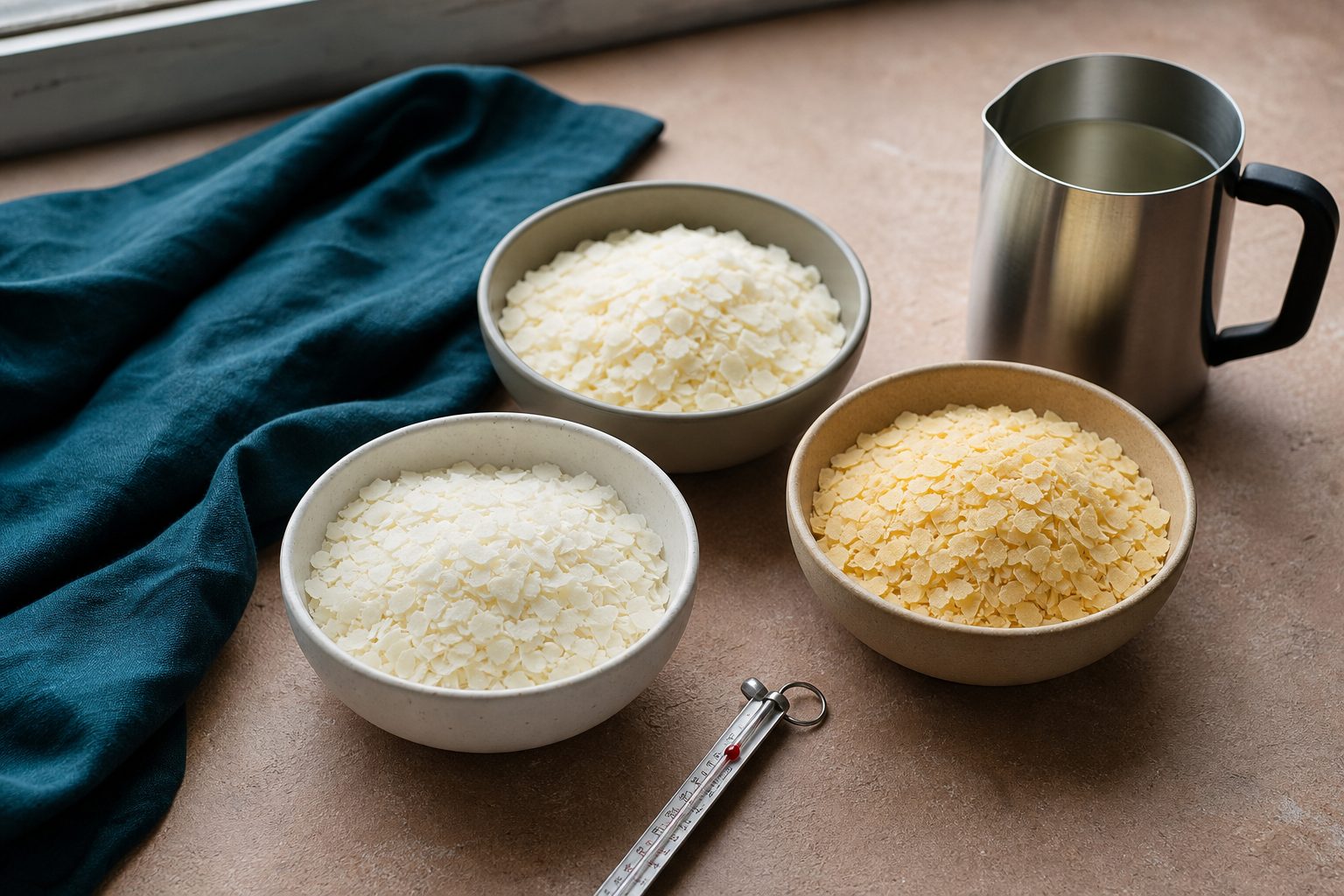
For a market table, the honest answer is that a coconut and soy blend gives you the easiest sale and the fussiest pour, straight soy gives you the cheapest pound and the most cosmetic complaints, and paraffin gives you the strongest scent throw and the customer conversation you may not want to have. None of the three is wrong. The right one is the one whose failure mode you can live with every single week.
Wax choice is not really a preference question. It sets your pour temperature, your cure window, how much fragrance oil you can carry, how many wick sizes you have to stock, and how much of your labor goes into reheating tops. Those all show up in cost per unit before they ever show up in a review.
What follows is how the three families actually behave on a small production bench, with the arithmetic laid out so you can run it against your own supplier invoices.
Melt point, pour temperature and cure window by wax type
Every container wax has three temperatures that matter: the melt point, the temperature you add fragrance, and the temperature you pour. Miss the third and you get sinkholes or wet spots no matter how good your recipe is.
| Wax family | Typical melt point | Typical pour range | Practical cure before selling |
|---|---|---|---|
| Straight soy container wax | Around 115 to 125 F | Roughly 130 to 145 F | 7 to 14 days |
| Coconut and soy blend | Around 105 to 120 F | Roughly 125 to 140 F | 7 to 10 days |
| Paraffin container wax | Around 125 to 135 F | Roughly 155 to 175 F | 3 to 5 days |
Treat those as starting points, not gospel. Your supplier publishes a technical data sheet for the exact wax you buy, and that sheet beats any chart including this one. Print it and keep it with your recipe card.
The cure column is the one that quietly runs your calendar. Paraffin reaches close to full throw in a few days. Soy keeps developing for a week or two as the crystal structure settles and the fragrance binds. If you pour on a Thursday for a Saturday market, soy is going to underperform what you smelled in testing, and you will blame the fragrance oil when the problem was the calendar.
Keep reading: How long should soap really cure before I ship it, and how do I track that?
Fragrance load limits and how scent throw differs
Fragrance load is expressed as a percentage of total wax weight. Most container waxes are rated to hold somewhere between 6 and 12 percent, and coconut blends generally sit at the top of that range because the softer oil structure has more room to carry oil.
More load is not more throw. Past the wax's holding capacity the oil separates, pools at the top or sweats out of the surface, and the extra oil actively hurts the burn by feeding the flame unevenly. The wax data sheet gives you the ceiling. Stay under it.
Cold throw versus hot throw
Cold throw is what the customer smells when she lifts the lid at your table. Hot throw is what she gets at home an hour into the burn. Soy tends to give a pleasant cold throw and a modest hot throw. Paraffin tends to reverse that, quiet in the jar and assertive once lit. Coconut blends usually give you the most consistent pair, which is why they dominate the boutique shelf.
If your market sales depend on the lid test, that argues for a blend. If your business is repeat online reorders, hot throw is what earns the second order.
Frosting, wet spots and other cosmetic behaviors buyers notice
Frosting is the white crystalline bloom that appears on soy surfaces and sides. It is the natural vegetable wax recrystallizing, it is not a defect, and it does not affect burn. Customers do not know that. Some read it as mold.
Wet spots are the cloudy patches where wax has pulled away from the glass as it cooled and contracted. They come and go with room temperature and they are almost impossible to eliminate in an unheated studio in winter.
- Soy: frosting likely, wet spots common, often needs a second pour to level the top.
- Coconut blend: creamy smooth tops, resists frosting well, sensitive to fast cooling and drafts.
- Paraffin: glass adhesion is excellent and tops set flat, but sinkholes in the center are routine.
Whatever you pick, write one honest line on your product page about it. A sentence explaining that natural soy frosts is cheaper than a refund.
Keep reading: What should I do when a customer says a candle tunneled or a bar irritated their skin?
Wick pairing and how much testing each wax demands
Wick sizing is a function of wax family, vessel diameter, fragrance oil and dye. Change any one and the test starts over. That is the real cost difference between waxes, and it does not appear on any invoice.
Coconut blends burn softer and usually need a smaller wick than you expect for the diameter. Paraffin liquefies fast and generally takes a smaller wick than soy in the same jar. Soy is stiff and often needs stepping up a size or two.
A defensible test protocol per wax and vessel combination looks like this:
- Pour three jars per candidate wick size, minimum three sizes.
- Cure the full window for that wax before lighting anything.
- Burn in four hour sessions, trimming to a quarter inch each time.
- Record melt pool depth and diameter, flame height, mushrooming, soot and container temperature at the end of each session.
- Burn to the bottom. Many wicks look perfect for three sessions and overheat on the last inch.
That is nine to twelve jars and two to three weeks per combination. Budget it as a real production cost, because it is one.
Cost per pound and how it moves your unit economics
Here is the arithmetic with assumptions stated plainly. These are illustrative numbers. Substitute your own invoice and your own jar quote.
Assume an 8 ounce net fill candle, a jar and lid at $2.40, a wick and sticker at $0.15, a label at $0.12, fragrance oil at $22 per pound, and a 9 percent fragrance load. Nine percent of 8 ounces is about 0.72 ounces of fragrance and about 7.28 ounces of wax.
| Line | Soy at $2.60 per lb | Coconut blend at $3.90 per lb | Paraffin at $2.20 per lb |
|---|---|---|---|
| Wax, 7.28 oz | $1.18 | $1.77 | $1.00 |
| Fragrance, 0.72 oz | $0.99 | $0.99 | $0.99 |
| Jar, lid, wick, label | $2.67 | $2.67 | $2.67 |
| Materials per unit | $4.84 | $5.43 | $4.66 |
The spread between the cheapest and dearest option is 77 cents on a candle that probably retails between $24 and $32. That is under 3 percent of retail. Meanwhile a single reheat pass to fix soy tops costs you maybe 20 seconds of labor per jar, and one refunded order wipes out the savings on roughly thirty candles.
So the conclusion is uncomfortable but useful: wax cost per pound is close to irrelevant at small batch scale. Choose on labor, cosmetics and throw, then negotiate price later when volume gives you leverage.
See how WickAndWax handles this for candle and soap making businesses
Supply consistency and lot to lot variation
Soy is an agricultural commodity. Slabs from different crop years and different processing runs can behave differently at the same pour temperature, and suppliers occasionally reformulate with limited notice. Coconut blends are proprietary formulas, so you are dependent on one supplier keeping the formula stable. Paraffin, being a refinery product, is the most consistent of the three batch to batch.
The practical defense is the same for all three: record the supplier lot number for every wax and fragrance container the moment it comes off the pallet, and tie that lot to every batch you pour from it. When the tops start setting differently in March, you want to be able to see that batches 41 through 58 all came from one wax lot.
How to run a fair comparison test in your own studio
Test one variable. That is the whole discipline, and it is what most maker comparisons get wrong.
- Fix the vessel, the fragrance oil, the load percentage and the room. Vary only the wax.
- Pour three jars of each wax on the same day, from the same fragrance bottle.
- Wick each wax to its own correct size. Using one wick across all three tests the wick, not the wax.
- Cure every jar for the longest window in the trial, so soy is not penalized for needing two weeks.
- Do the cold throw check blind. Cover the jars, number the lids, have someone else shuffle them.
- Burn all nine in the same room on the same day and log melt pool, throw at fifteen feet, and appearance at hour four.
- Then price it out with your real numbers and decide.
Expect the trial to take a month. Run it once and you will not need to run it again for two years.
Where this leaves you
Pick the wax whose weaknesses you can explain to a customer without flinching, then hold it steady long enough to build real testing data behind it. Switching waxes every season means you never accumulate the wick and cure knowledge that makes production calm.
The part that survives every wax decision is the record: which wax lot, which fragrance lot, which pour date, which wick, which jars went into which orders. WickAndWax keeps that batch record for you, prints the label for each batch, and links the finished units back to the orders they shipped in, so when a wax lot behaves differently you can see exactly how far it reached.
Read also
How long should soap really cure before I ship it, and how do I track that?
Cure time affects hardness, mildness and how a bar holds up in transit. A working system for setting cure dates per batch and knowing which rack is ready to pack.

What should I do when a customer says a candle tunneled or a bar irritated their skin?
A complaint is a traceability question first and a service question second. How to find the lot, judge whether it is a real defect, respond well and decide about a recall.
Is it worth moving from farmers markets into wholesale accounts over the next year?
Wholesale trades margin for volume and predictability, and it raises the bar on labeling, lot codes and lead time. What changes in the work when a shop places a standing order.